A. B. C. D. & E.
Our Component Program
ICON-SP believes that lasting peace, social justice, and environmental sustainability are inseparable. Through integrated, community-driven programs, we empower Indigenous Peoples, Moro, and Christian communities to become resilient, self-reliant, and united in building peaceful and sustainable futures.
Expanded Peace Building Program (EPB)
The Expanded Peace Building Program strengthens peace, environmental stewardship, sustainable livelihoods, and community governance. By integrating conflict transformation with climate resilience and economic empowerment, EPB enables communities to become active builders of lasting peace.
Growing local peace champions
Peace begins with empowered communities. Peace Facilitators (PFs) are trained as mediators and community leaders, supporting barangay conflict resolution mechanisms such as the Lupon Tagapamayapa while promoting intercultural understanding among Indigenous Peoples, Moro, and Christian communities.
Healthy ecosystems, thriving cultures
This component strengthens environmental conservation while protecting indigenous knowledge, traditions, and cultural identity — equipping communities to respond to climate change through environmental education, disaster risk reduction, watershed conservation, mental health and psychosocial support, and community-based environmental networks.
Inclusive economic opportunity
This component promotes climate-smart agriculture, community enterprises, sustainable livelihoods, and value chain development that increase household incomes while protecting natural resources — giving vulnerable families pathways toward long-term economic security.
Institutions that outlast a single project
Building on the People's Peace Network (PPN), this component strengthens local peace infrastructures through policy advocacy and institutional development. The new People's Peace Network Center (PPNC) and Legal Resource Peace Center expand access to justice, human rights protection, legal assistance, and policy research.
Human Rights & Justice
Lasting peace rests on justice and the protection of every person's dignity. This program equips Indigenous Peoples, Moro, and Christian communities to know, claim, and defend their rights — building local legal capacity, documenting and responding to rights violations, securing ancestral domains, and opening pathways to fair and accessible justice.
Rights knowledge rooted in the community
Community leaders, women, and youth are trained as paralegals who understand national laws, customary justice systems, and local ordinances — able to guide neighbors through legal processes, assist in mediation, and serve as the first line of support when rights are at risk.
Every case recorded, every voice heard
This component monitors, documents, and reports human rights concerns affecting vulnerable communities, including displacement, threats to land defenders, and gender-based violence — ensuring accurate records that support protection, redress, and accountability.
Securing land, identity, and self-governance
Guided by the Indigenous Peoples’ Rights Act (IPRA), this component supports Indigenous communities in delineating and titling their ancestral domains, strengthening Indigenous Political Structures, and upholding Free, Prior and Informed Consent (FPIC) in decisions that affect their lands and resources.
No one walks the justice process alone
Through the Legal Resource Peace Center and partner lawyers, individuals and communities receive legal advice, referral to appropriate agencies, and accompaniment through barangay, administrative, and court proceedings — closing the gap between rights on paper and justice in practice.
Changing the systems that shape people’s lives
Grounded in community evidence, this component engages local government units, national agencies, and peace networks to advance policies and institutional reforms that protect human rights, recognize Indigenous Peoples, and strengthen inclusive, rights-based governance.
Cultural Integrity Learning Enhancement & Educational Support Program (CILE-ESP)
Education is a powerful pathway toward peace, leadership, and cultural preservation. CILE-ESP empowers young people while protecting indigenous heritage through scholarships, Schools for Living Traditions, and lifelong learning opportunities.
Scholarships for deserving, financially disadvantaged students
TPYS provides educational opportunities for deserving yet financially disadvantaged students from Indigenous, Moro, and Christian communities — nurturing responsible leaders through values formation, climate action, leadership development, and community service.
- Early Childhood Care and Development (ECCD)
- Mental Health-related Programs
- Agriculture
- Forestry
- Social Work
- Food Processing & Sustainable Technologies (FBPST)
- Technical-Vocational Skills Training for Out-of-School Youth (OSY)
- Special Professional Scholarships: Law, Medicine, Ethnology, Environmental Studies
- Student Housing & Accommodation Support
Centers for indigenous knowledge and innovation
Former Early Childhood Care and Development (ECCD) centers are gradually transformed into vibrant learning hubs where communities preserve cultural heritage while creating sustainable livelihood opportunities.
- Ethnolinguistic Research and Development
- Indigenous Arts, Textiles, and Traditional Crafts
- Indigenous Product Development, Enterprise, and Marketing
- Cultural Heritage Preservation and Community Education
Integrated Women's Empowerment, Peace, Human Rights & Environmental Sustainability (IWEPHES)
Women are powerful agents of peace and sustainable development. This three-year integrated program strengthens women's leadership in governance, peacebuilding, environmental protection, human rights advocacy, and community enterprise — developing women leaders who create safer, more resilient, and inclusive communities.
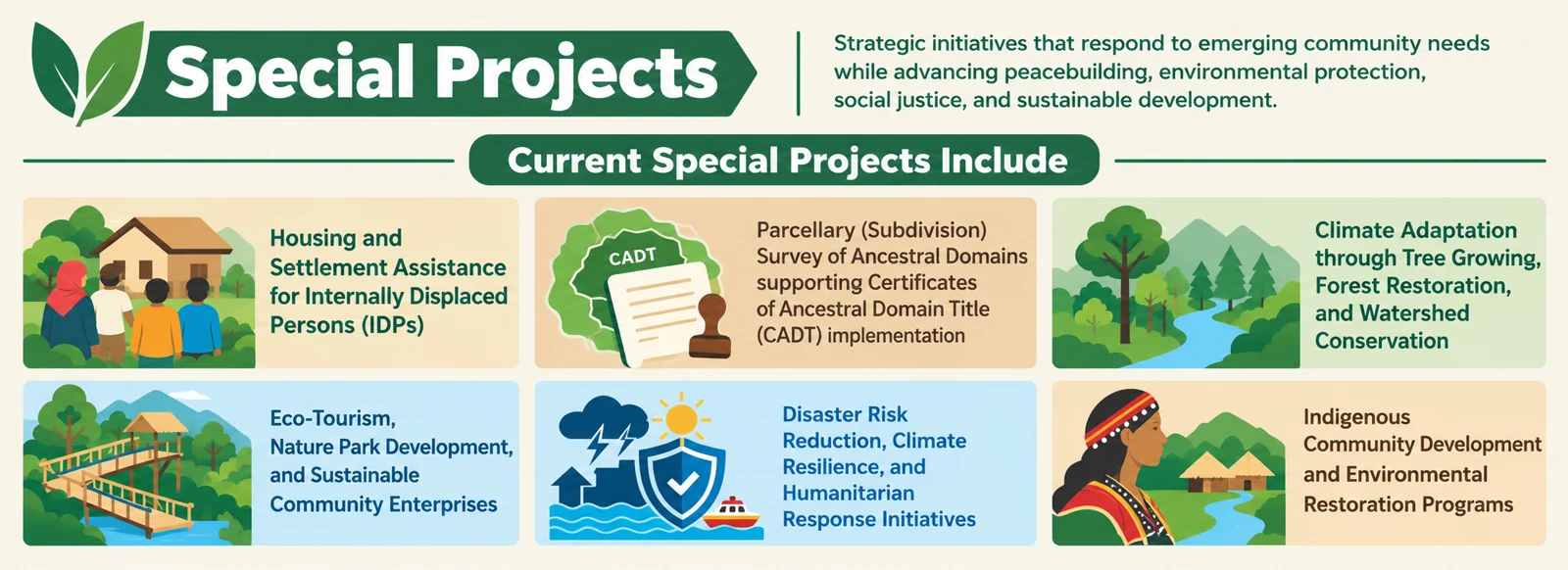
Special Projects
Strategic initiatives that respond to emerging community needs while advancing peacebuilding, environmental protection, social justice, and sustainable development.